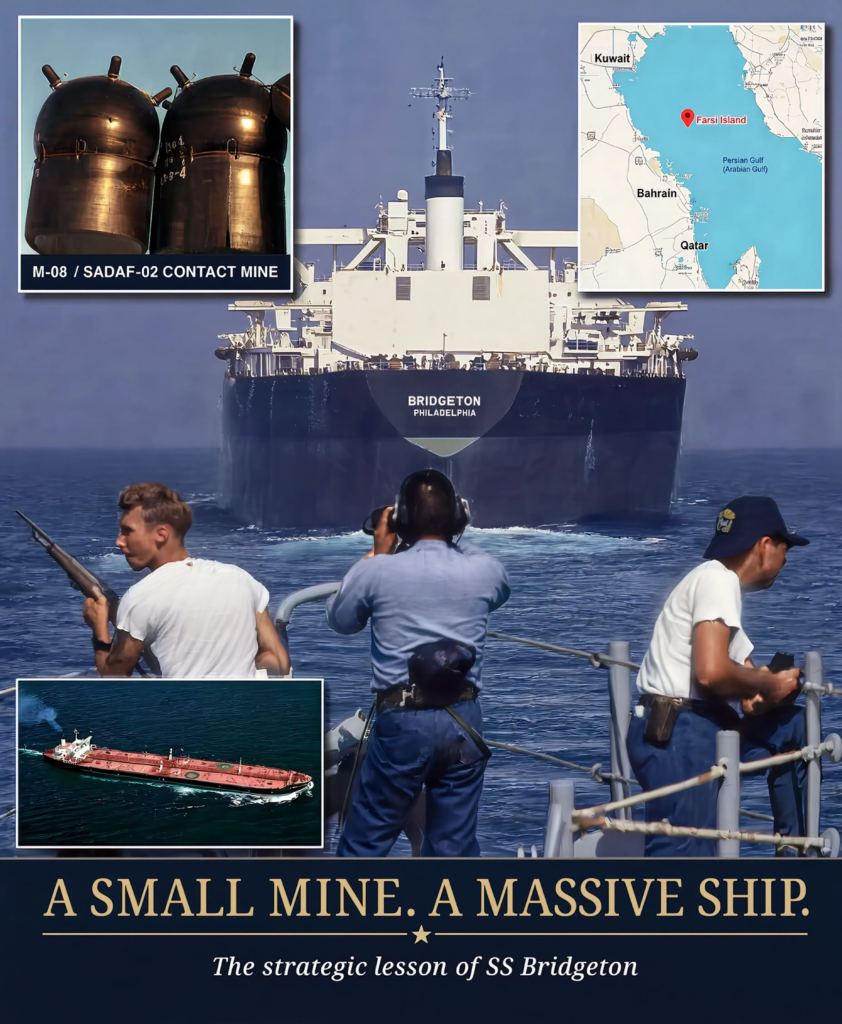
39 years ago today, on 24 July 1987, the supertanker SS Bridgeton struck an Iranian mine in the Persian Gulf.
The explosion occurred during the first convoy of Operation Earnest Will, the US mission established to protect reflagged Kuwaiti tankers during the Tanker War phase of the Iran-Iraq War.
The origins of the crisis stretched back several years. Following Iraqi attacks on Iran’s oil export facilities at Kharg Island in 1984, the conflict spread to commercial shipping. By 1987, more than 200 merchant ships had been damaged in the wider Gulf conflict, insurance costs had surged, and Kuwait sought American protection for its tankers.
Kuwait’s request for protection led to Operation Earnest Will. At the centre of the first convoy was Bridgeton, one of the largest ships in the world at the time. Originally launched in 1977 as Al-Rekkah, the Ultra Large Crude Carrier measured approximately 352 metres long, 51 metres wide, and could carry around 414,000 tonnes of cargo, fuel, water and stores.
The convoy’s departure time, route and speed had attracted significant media attention. According to later accounts, Iranian forces laid mines near the well-known transit route around Farsi Island, located beside one of the Gulf’s principal shipping corridors. During the night before the convoy, Iranian forces reportedly laid multiple lines of mines across the route.
Roughly 13 nautical miles west of Farsi Island, Bridgeton struck a mine. The blast tore a hole approximately 10 metres by 5 metres in steel plating over 27 mm thick. To provide some perspective – a naval warship has five-eighths of an inch steel hull plating. The giant tanker remained afloat, retained propulsion and completed her voyage.
Captain Walter Seitz later recalled that the shock wave travelled throughout the ship, feeling much like a heavy impact from a large sea wave and powerful enough to almost knock him off his feet.
With concern that additional mines might be present, the escorting warships fell in behind Bridgeton and followed in her wake through the suspected danger area. This was a practical response to a difficult tactical problem.
A relatively inexpensive mine had dictated the actions of a USN-escorted convoy and exposed a vulnerability that many Western navies had not seriously confronted since World War II. The incident demonstrated how asymmetric warfare can alter the behaviour of even the most powerful fleets.
Thirty-nine years later, as attention once again turns to maritime security in the Strait of Hormuz, the same lesson is being relearned, asymmetric warfare can alter the behaviour of even the most powerful fleets.
Leave a Reply
You must be logged in to post a comment.