Australia talks a lot about submarines. And not enough about sea mines.
Mine warfare remains one of the cheapest, fastest, and most effective ways to create strategic disruption.
That point came through clearly in a recent discussion featuring Jennifer Parker on mine warfare and maritime vulnerability, and it deserves far more attention in Australia.
Around 99% of Australia’s trade moves by sea, and approximately 91% of our fuel is imported. A small number of sea mines could disrupt ports, choke points, fuel imports, and debilitate commercial confidence. This has been well demonstrated by Iranian actions in the Strait of Hormuz. Simply declaring an area mined can be enough to halt shipping.
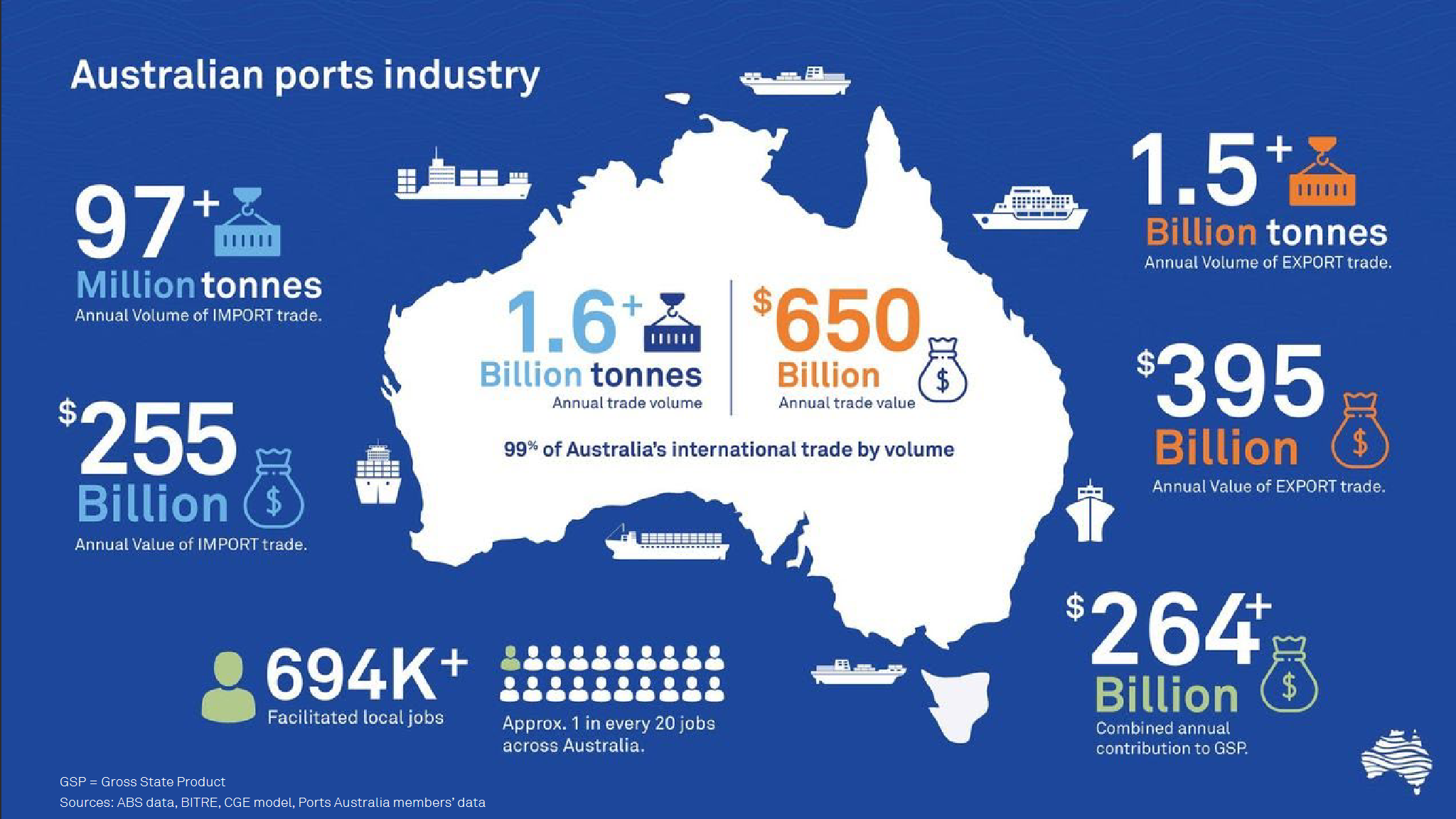
Ports Australia – 2024 Economic Impart Study – State of Trade.
Jennifer also raised an uncomfortable but important reality: the cancellation of SEA 1905 appears to have left Australia quite exposed at a time when mine warfare threats are becoming more relevant, not less.
Mine warfare is rarely discussed in Australia compared with submarines, frigates, and other headline capabilities. Yet relative to those investments, mine warfare is significantly cheaper, and arguably just as critical.
If Australia expects to protect trade routes, ports, and forward operating areas, it needs a credible mine countermeasures capability, including the ability to deploy it where and when required.
The second half of the discussion focused on autonomy and unmanned systems. These technologies absolutely matter and will play an increasingly important role. But autonomy alone is not a silver bullet.
Australia’s challenges include geography, access to launch and recovery sites, logistical support, and operating under real world threat conditions. Effective mine countermeasures remain far more complex than they may first appear.
That is why some approaches by other nations are worth watching closely, particularly those that combine remote and autonomous systems with low signature crewed platforms.
These platforms are able to operate outside a mine threat area, but also enter it when necessary, appear closer to the emerging gold standard than any “autonomy solves everything” narrative.
This was an important conversation, and one Australia should be having more openly, more honestly, and with greater urgency.