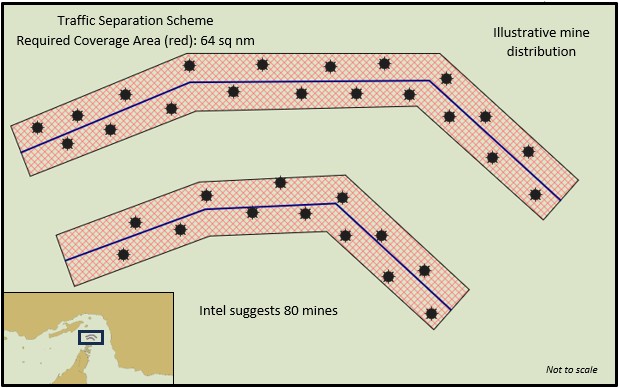
Recent reporting suggests that clearing an estimated 80 sea mines from the Strait of Hormuz could take around two months to complete.
The Strait of Hormuz Traffic Separation Scheme (TSS) is approximately 16 nautical miles long and consists of two shipping lanes, 2 nautical miles wide. Together, that represents roughly 64sq nautical miles of waterspace.
If all 80 mines were laid within those lanes, the average density would be 1.25 mines per square nautical mile. In other words, the problem isn’t just the mine density, it is the magnitude of area that must be searched.
Assuming an autonomous underwater vehicle (AUV) with a sonar swath of 80 metres, a single run over the designated area will consist of 1,500 nautical miles of survey tracks. Multiple vehicles can reduce the survey phase, but they do not remove PMA, launch and recovery, deconfliction, data management, vehicle endurance, battery replacement, reacquisition, identification, neutralisation or re-clearance issues.
Even with automated target recognition/AI, a simplified first-pass estimate suggests achieving sufficient confidence will take at least 4 to 5 weeks, this is assuming no mines are found. And that is only the search phase in the TSS.
Once mines are detected, operations become more complex. Survey effort may need to increase, additional investigation required, mines must be positively identified, neutralisation assets deployed, and clearance has to be validated before confidence can be restored.
Every confirmed mine will generate additional work and extends the timeline.
Operators have to distinguish where the mines are, but to do so they will need to sort through everything else on the seabed that looks minelike. Every discarded object (thrown over the side of a ship), rocky outcrop, lost anchor, shipping container, fishing gear or sonar anomaly can become a contact of interest, often in need of further investigation before it can be dismissed. This is often tedious work, and requires great patience.
Seabed composition, terrain, debris and environmental conditions may effect sonar conditions and delay progress. This is why sea mines remain one of the most strategically effective maritime weapons. They can be laid in hours, yet they are able to impose military, economic and psychological effects lasting for weeks, months or even years.
For mine warfare and MCM professionals, the Strait of Hormuz will be an important case study in how far distributed, autonomous and remotely operated mine countermeasure capabilities have progressed, and importantly, where our capability gaps reside.
Operating from a distance, completing the MCM kill chain, and potentially doing so in contested waters, appears to be one of the hardest problems in naval warfare.
Leave a Reply
You must be logged in to post a comment.